You are here
 - Lecythidaceae -
 Allantoma (8)
- Asteranthos (1)
- Bertholletia (1)
- Cariniana (10)
- Corythophora (6)
- Couratari (20)
- Couroupita (4)
- Eschweilera (96)
- Grias (11)
- Gustavia (47)
 Lecythis (33)
- = Bergena
- = Cercophora
- = Chytroma
- = Holopyxidium
- = Pachylecythis
- = Sapucaya
- Lecythis alutacea (3)
- Lecythis ampla (6)
- Lecythis barnebyi
- Lecythis brancoensis
- Lecythis chartacea (27)
- Lecythis confertiflora (1)
- Lecythis corrugata (4)
- Lecythis gracieana
- Lecythis holcogyne (4)
- Lecythis ibiriba (1)
- Lecythis idatimon (7)
- Lecythis lanceolata (13)
- Lecythis lurida (10)
- Lecythis mesophylla
- Lecythis minor (8)
- Lecythis ollaria (3)
- Lecythis parvifructa
- Lecythis persistens (2)
- Lecythis pisonis (21)
- Lecythis pneumatophora
- Lecythis poiteaui (4)
- Lecythis retusa (3)
- Lecythis schomburgkii (2)
- Lecythis schwackei (1)
- Lecythis serrata
- Lecythis tuyrana (4)
- Lecythis zabucajo (7)
Lecythis ibiriba (Miers) N. P. Sm., S. A. Mori & Popovkin
Nomenclature
-
Genus: Lecythis



SUMMARY
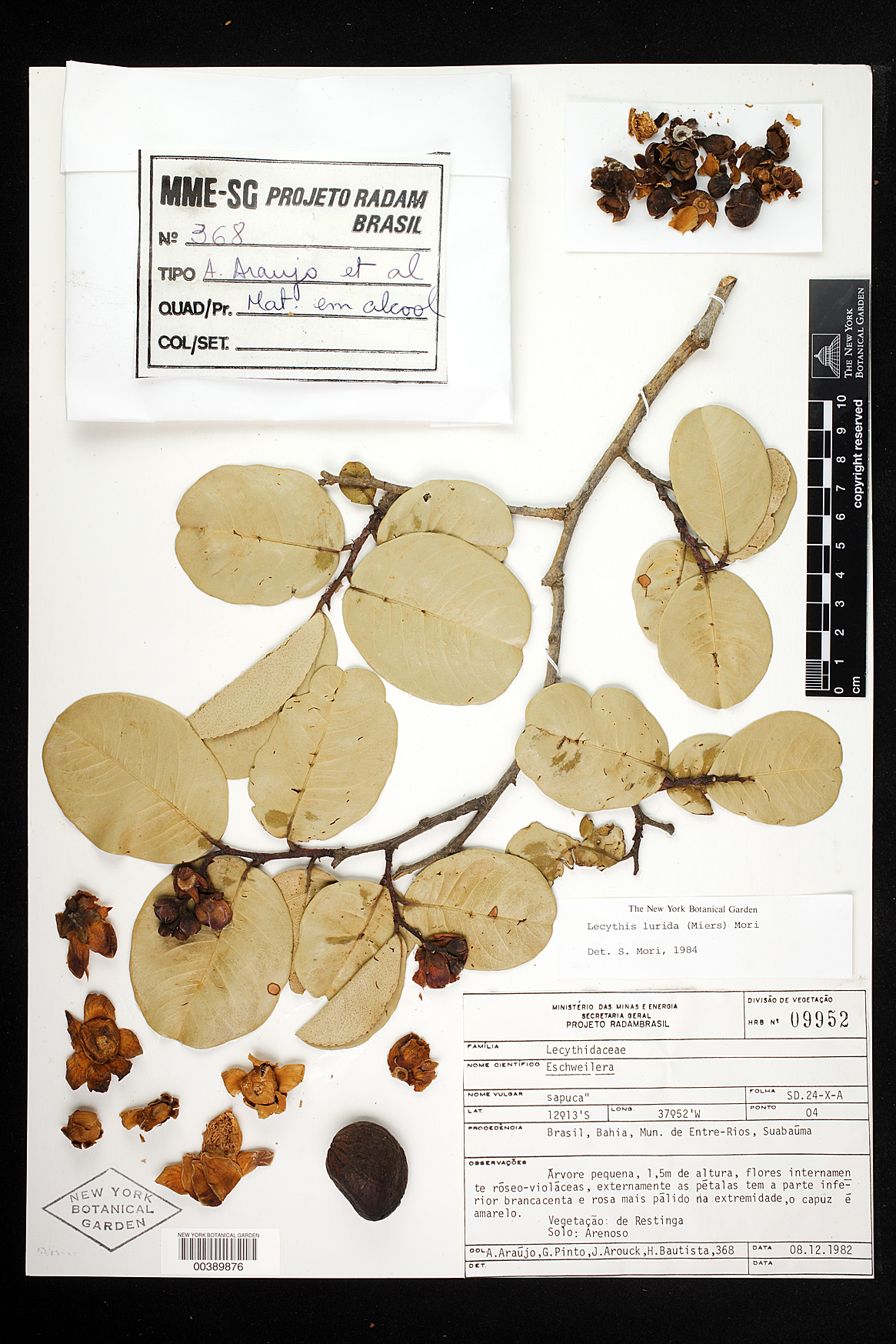
Shrubs or small to medium trees, to 20 m tall but usually under 10 m. Bark slightly fissured when young, becoming thick and corky, with deep fissures when old, the outer bark thinner than inner bark, the inner bark beige. Twigs glabrous, the young bark green to reddish brown, often peeling; lenticels conspicuous on younger growth. Leaves present at flowering; petioles 3–10 mm long, slightly canaliculate; blades elliptic, ovate, oblong, obovate, or nearly round, 3.8–14.5 x 2.5–8.5 cm, glabrous, coriaceous, the abaxial side not whitish, without cuticular papillae, usually with conspicuous reddish-brown punctations, the base rounded to slightly cuneate or attenuate, often narrowly decurrent onto petiole, the margins slightly crenulate (apices of protrusions rounded) to nearly entire, often revolute, the apex rounded to short acuminate or acute, sometimes emarginate; venation brochidodromous to weakly eucamptodromous, the secondary veins in 7–15 pairs. Inflorescences terminal, rarely in axils of leaves, spikes, the rachis 0.8–8.5 cm long, rarely almost absent, with 1–15 flowers, glabrous, lenticellate. Flowers 2.5– 6.0 cm diam., glabrous, sessile or nearly so, subtended by one caducous bract and two caducous bracteoles; calyx-lobes 6, ovate, 0.5–1.2 x 0.3–0.9 cm, imbricate, with longitudinally oriented mucilage-bearing ducts (best seen in cross section), green, sometimes purplish-green centrally and basally, sometimes slightly thicker towards center; petals 6, subequal, rotund, oblong to oblanceolate, or obovate, 1.5–3.5 x 3 0.8–2.0 cm, pink to red or white with tinges of pink and red, the outer surface often dark red with white margins in bud, tightly appressed to androecium at base; androecium zygomorphic, the staminal ring flat, with 112–176 stamens, staminal lip present, the filaments 1.0–3.5 mm long, white, clavate, the anthers 0.5–1.0 mm long, yellow, the hood 1.8–3.0 x 1.3–2.5 cm, nearly flat, often slightly wrinkled on outer surface, white to yellowish, with 82–106 vestigial stamens, the vestigial stamens mostly inserted at apex of ligule but sometimes present between androecial ring and hood appendages, 3–12 mm long, stalked, yellow, curved but not swept inward, staminodes absent; ovary (2–)4(5)-locular, with mucilage ducts (only seen in cross-section), the ovules 4–12 per locule, inserted at base or middle of septum, the style obliquely oriented, ca. 3–4 mm long. Fruits usually dehiscent, but sometimes falling to ground without dehiscing, sub-globose to turbinate, 5.5–6.5 cm, the umbo sometimes pronounced, the pericarp 1–5 mm thick, the calycine zone sometimes conspicuous. Seeds 2–4 per fruit, 2.0–4.5 x 2.0–4.2 cm, the testa thin, less than 1 mm thick, chestnut colored, the veins impressed, dendritically arranged; aril present, basal, small and poorly developed.