You are here
Field Image (fruits & seeds)
Stem, leaves, and fruit of Lecythis pisonis.
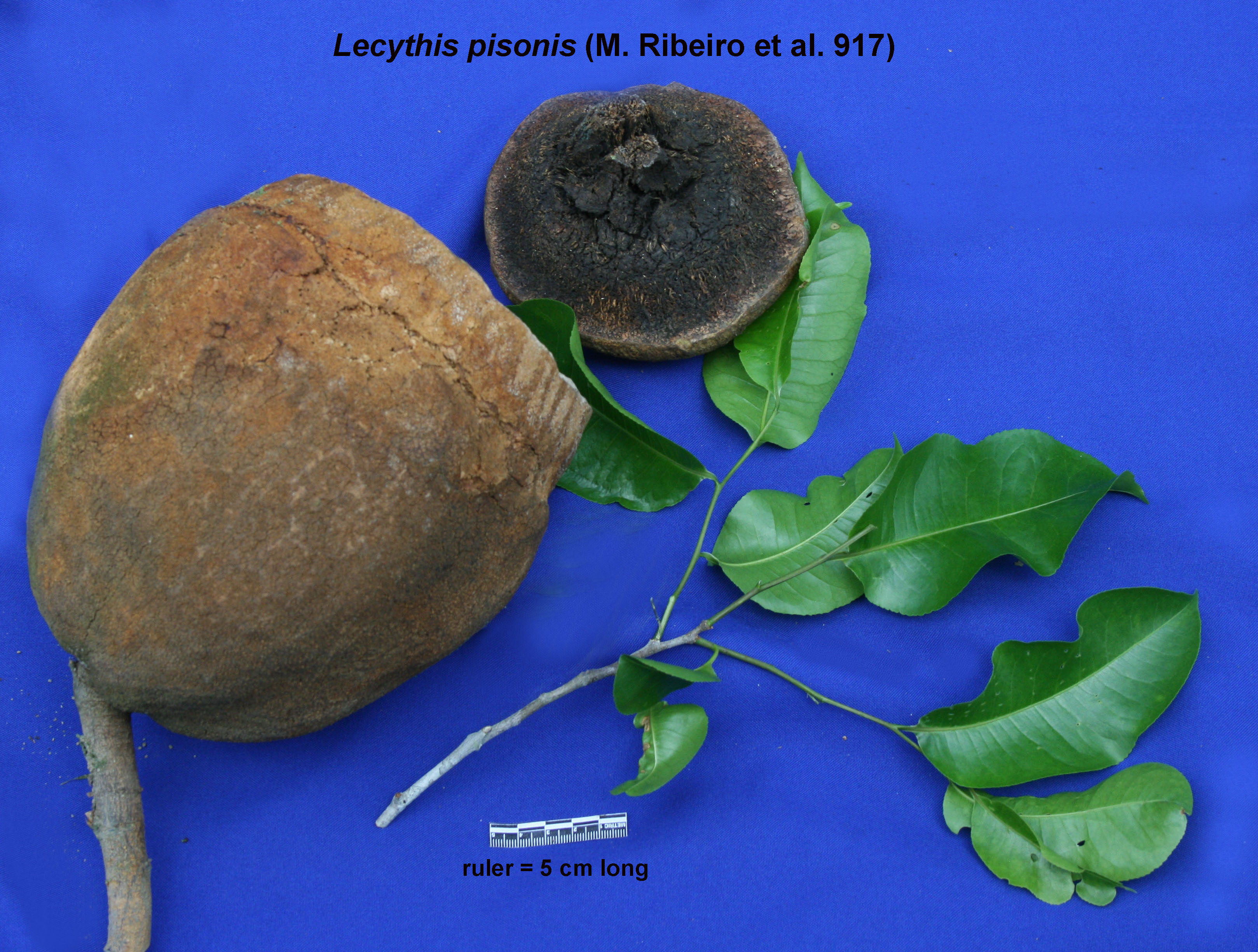
 Stem, leaves, and fruit of Lecythis pisonis.
Specimen image of Lecythis pisonis showing the stem, leaves, and fruit based on M. Ribeiro et al. 917 from the state of Espírito Santo, Brazil. Note that this image can serve as a substitute for the herbarium specimen if the latter is lost.
Herbarium collection of fruits of Bertholletia excelsa.
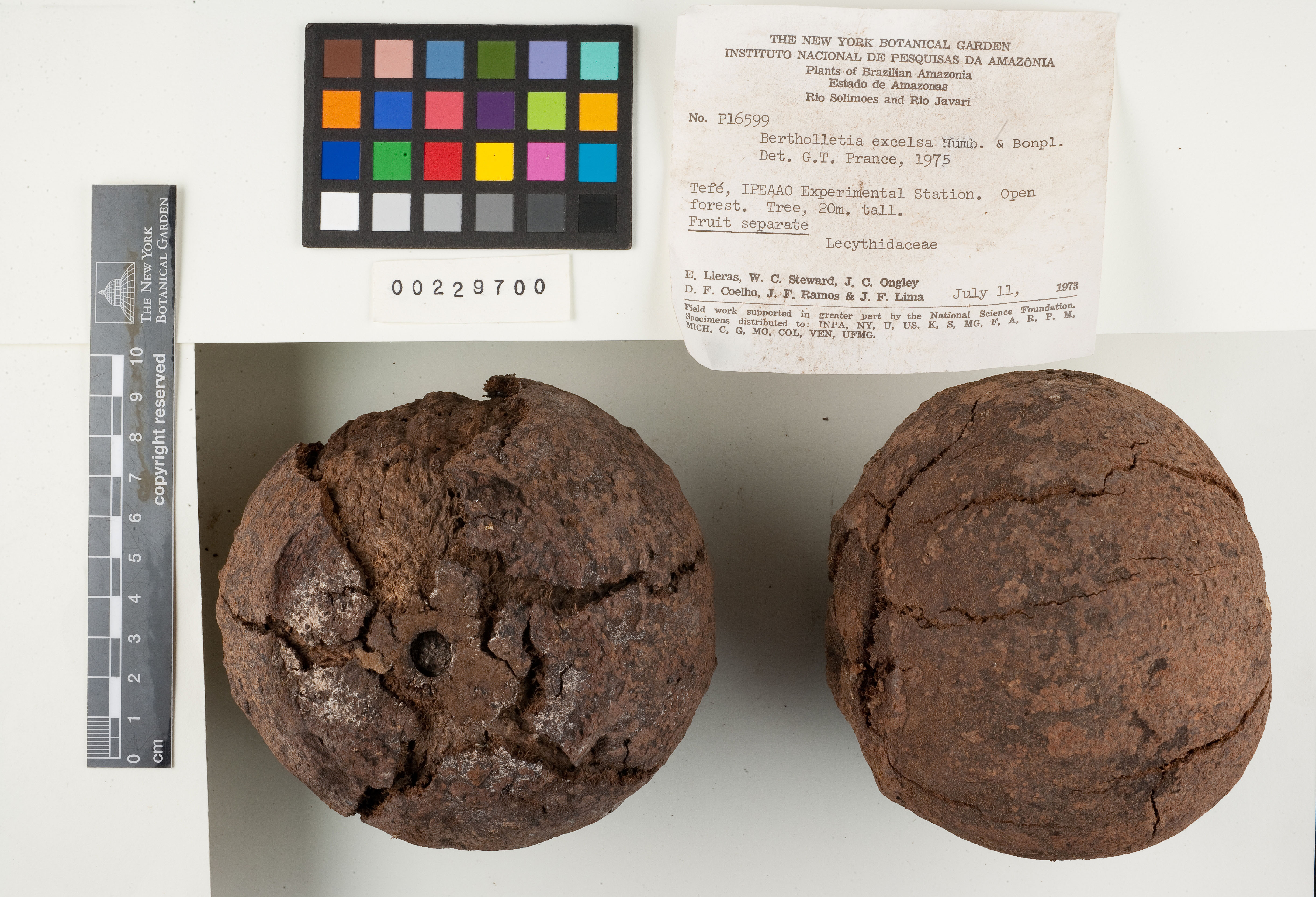 Herbarium collection of fruits of Bertholletia excelsa.
Herbarium collection of fruit at NY based on E. Lleras et al. P16599 from the state of Amazonas, Brazil. The "P" in front of the number indicates that this collection was given a number in the collecting series of G. T. Prance. The fruit on the left is an apical view showing the small opercular opening and the fruit on the left is in lateral view.
Pollination and dispersal of the sapucaia.
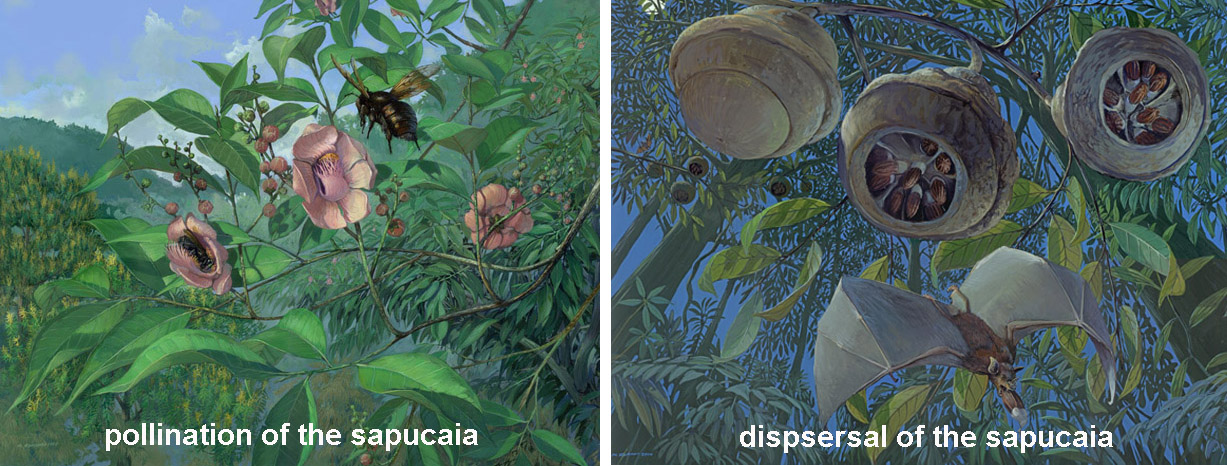 Pollination and dispersal of the sapucaia.
On the left: flowers of the sapucaia (Lecythis pisonis) being visited by female carpenter bees (Xylocopa frontalis). The bees collect sterile pollen from the anthers in the androecial hood for feeding the colony's larvae. During the visit, fertile pollen from the anthers of the staminal ring is deposited on the heads and backs of the bees. This pollen is subquently rubbed off onto the stigmas of subsequent flowers visited in other trees, thereby effecting cross-pollination. On the right: fruits of the sapucaia being visited by the greater spear-nosed bat (Phyllostomus hastatus). The bats carry away the seeds to their night roosts where they eat the white aril at the base of the seeds. Seeds that drop under the roost or while being carried away from the tree are. thus, dispersed by the bats.
A greater spear-nosed bat removing a seed from a fruit of the Sapucaia.
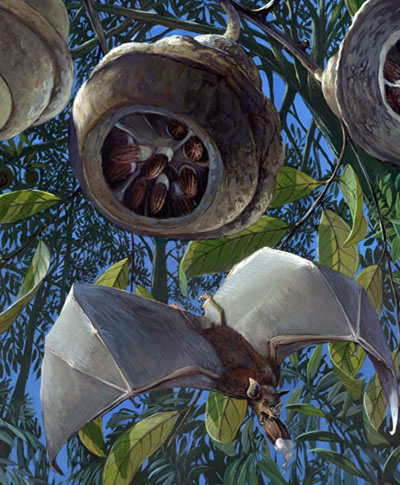 A greater spear-nosed bat removing a seed from a fruit of the Sapucaia.
A greater spear-nosed bat (Phyllostomus hastatus) removing a seed from a fruit of a sapucaia tree (Lecythis pisonis). Painting by Michael Rothman based on descriptions provided by Scott A. Mori.
Seeds of Couroupita guianensis. Photo by X. Cornejo.
 Seeds of Couroupita guianensis. Photo by X. Cornejo.
Seeds of Couroupita guianensis based on X. Cornejo & Grochowski 8030 from Jatun Sacha, Napo, Ecuador.
Seedling with cotyledons fully expanded. Photo by S. A. Mori.
 Seedling with cotyledons fully expanded. Photo by S. A. Mori.
Cultivated seedling of Couroupita guianensis, planted 19 Nov 1974; photographed 5 Dec 1974. Cotyledons leaf-like, opposite. Based on Mori collection number 3263 from Panama.
Cut fruit of Couroupita guianensis. Photo by X. Cornejo.
 Cut fruit of Couroupita guianensis. Photo by X. Cornejo.
Section of a fruit of Couroupita guianensis based on X. Cornejo & Grochowski 8030 from Jatun Sacha, Napo, Ecuador. Note that the seeds are embedded in a pulp and that they are somewhat flattened..
Cut fruit of Couroupita guianensis. Photo by J. Janovec.
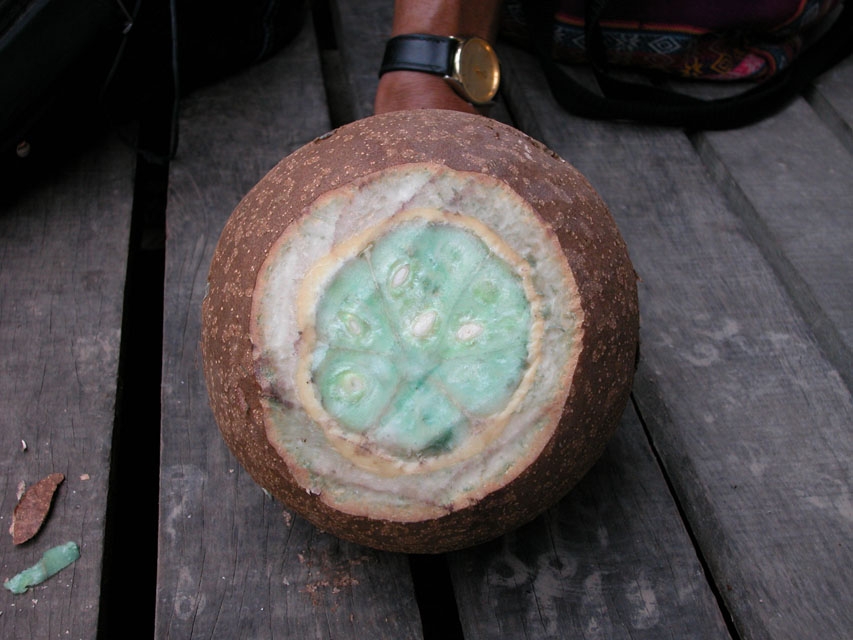 Cut fruit of Couroupita guianensis. Photo by J. Janovec.
Cut fruit of Couroupita guianensis showing pulp that has oxidized bluish-green. This image also shows the woody exocarp; the white, soft mesocarp; and the woody endocarp. From a native tree in Peru photographed by J. Janovec.
Seedling of Couroupita guianensis. Photo by S. A. Mori.
 Seedling of Couroupita guianensis. Photo by S. A. Mori.
Cultivated seedling of Couroupita guianensis, planted 19 Nov 1974; photographed 5 Dec 1974. The cotyledons are two, leaf-like, convoluted, and opposite to one another. Based on Mori collection number 3263. Panama.
Flowers and fruits of the cannon ball tree. Photo of tree in flower by A. Vasco-Gutierrez and in fruit by L. E. Gámez.
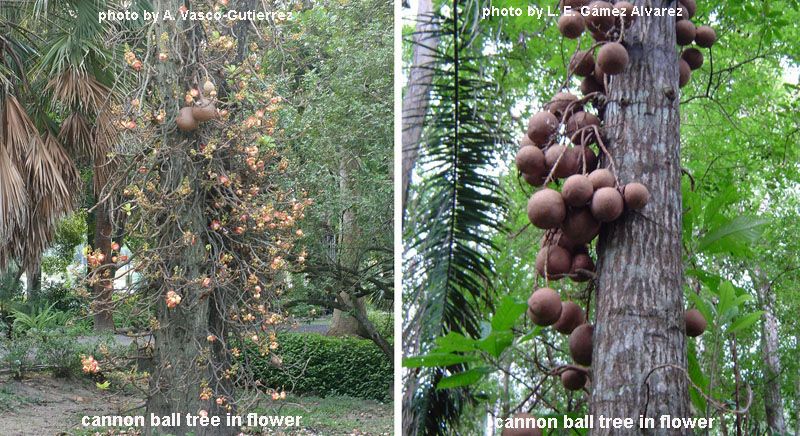 Flowers and fruits of the cannon ball tree. Photo of tree in flower by A. Vasco-Gutierrez and in fruit by L. E. Gámez.
Tree of Couroupita guianensis with cauline inflorescences and a few infructescences based on a non-vouchered tree cultived at the botanical garden in Caracas, Venezuela. Tree of Couroupita guianensis with mostly fruits based an unvouchered photo by L. E. Gámez Alvarez in Venezuela.